
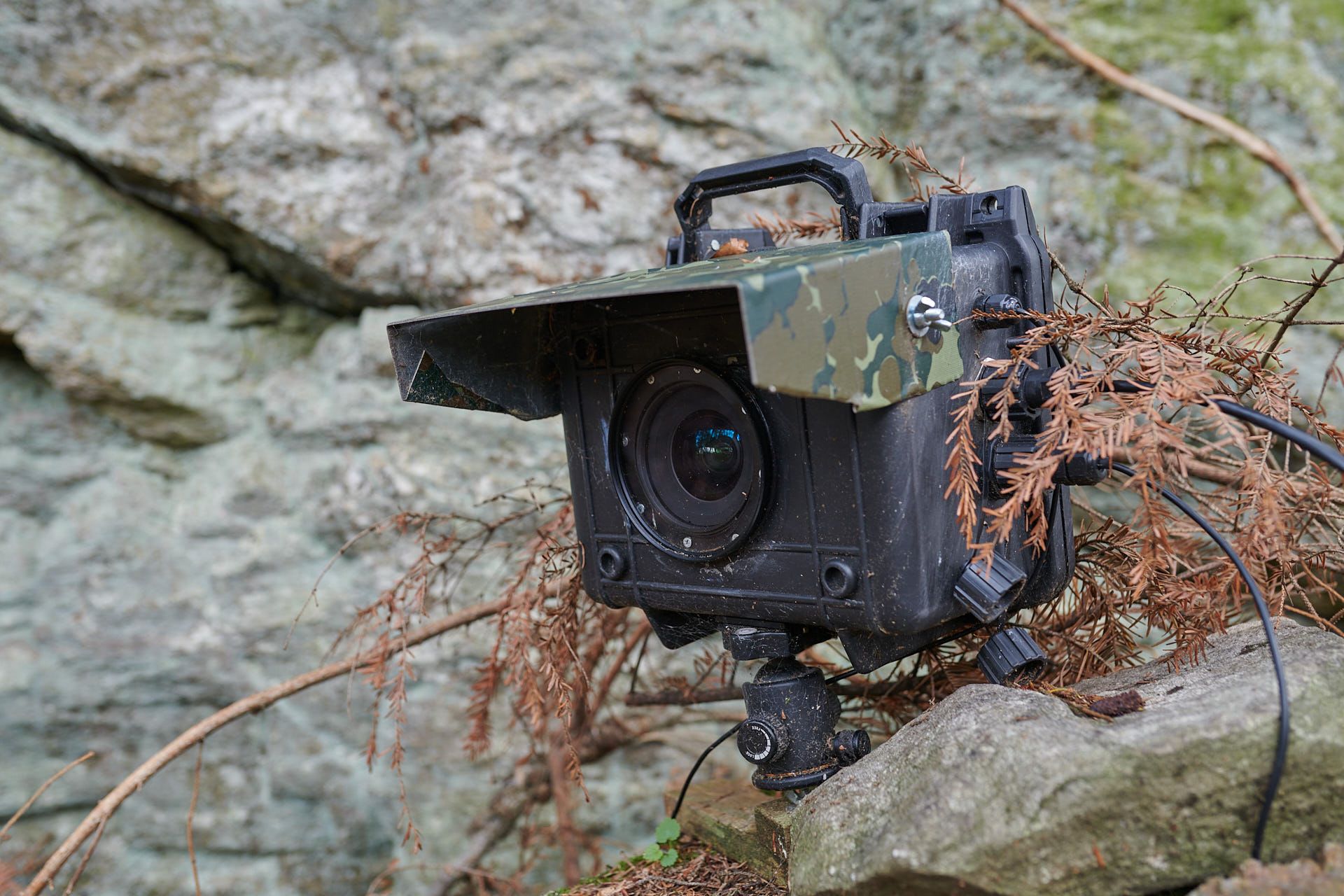

Camera traps are wonderful tools in wildlife photography and research as they allow animals to be observed undisturbed in their natural habitat. Two of the most common sensor types used in these devices are passive infrared sensors (PIR) and photoelectric sensors. Both technologies have their own modes of operation, advantages and ideal areas of application.
Passive infrared sensors (PIR)
PIR sensors detect movement by measuring infrared radiation emitted by warm objects such as animals or people. When a living creature enters the sensor's field of vision, it registers the change in thermal radiation and triggers the camera - just like a classic motion detector.
Advantages of PIR sensors:
- Wide detection field: PIR sensors can detect movement at a wide angle, making them ideal for monitoring larger areas.
- Energy efficiency: As they only react to changes in infrared radiation, they consume very little energy and therefore extend the battery life of the camera trap.
- Simple installation: PIR-based camera traps are often compact and do not require complex alignment or calibration.
Limitations of PIR sensors:
- Sensitivity to ambient temperatures: In very hot environments, the temperature difference between the animal and the environment can be small, which can impair detection performance.
- Limited range: The effective range of PIR sensors is often limited to a few meters, which can be suboptimal for detecting distant animals.
Light barriers
Light barriers consist of a transmitter, which emits a light beam (often infrared), and a receiver. If an object interrupts the light beam, this is registered by the receiver and the camera is triggered.
Vorteile von Lichtschranken:
- High precision: Light barriers can determine very precisely when an object passes a certain line, which is always useful if the animal is to be positioned at a very specific point in the image.
- Independent of temperature differences: As they react to physical interruptions of the light beam, they are not dependent on temperature differences and function reliably even in hot environments.
- Adjustable range: By correctly adjusting the light beam, the range of the light barrier can be adapted to the specific requirements of the location.
Limitations of light barriers:
- Need for precise alignment: The transmitter and receiver must be positioned very precisely to ensure that the light beam is detected correctly.
- Sensitivity to ambient conditions: Rain, fog, scattered light or dense foliage can impair the light beam and lead to non-triggering.
- Limited detection field: Light barriers only detect movements along the light beam, which limits their application to certain paths or narrow points.
Conclusion
Dhe choice between PIR sensors and photoelectric sensors depends on the specific requirements of the application. PIR sensors are versatile and easy to install, making them very suitable for general locations. Light barriers, on the other hand, offer greater precision and are ideal for photography in specific passages or paths.
An understanding of the respective advantages and disadvantages helps to select the optimum technology for the desired application.
I can't really give a clear recommendation. I use both variants at my locations - depending on what I want to achieve.
Finally, a very good introductory video comparing motion detectors and light barriers.