

The question comes reliably as soon as someone has booked a safari: which camera should I take? Usually the second one follows right away: do I need to buy something new for this? My answer to both: the camera is the smaller problem. What decides your pictures is the focal length, a steady rest and whether you can operate your gear blindly.
I have been shooting Nikon for more than 20 years, currently the Z8. The other brands are no worse, I am simply used to it, so I can say little about Canon and Sony from my own hands. The thoughts below apply to any system, though, and they come from rental cars and jeeps in Tanzania, South Africa, Kenya and India.
Which camera for a safari? Less important than you think
Almost any current mirrorless camera and any decent DSLR from the last ten years is good enough for great safari pictures. What I would really look for:
- Autofocus with animal eye detection. This is the biggest step forward of recent years. When a leopard lies between branches, the camera often finds the eye faster than I do.
- Dust sealing. The red dust in Tsavo settles everywhere. A camera without sealing usually survives it, but there is no need to make life harder for it.
- Usable noise up to ISO 6400. The most exciting minutes come just after sunrise and just before the end of the game drive, and that is when light is scarce.
- Batteries. Lodges usually have power, but not always on the road. At least two spare batteries belong in your bag.
What you don't need: 30 frames per second, 60 megapixels or a €6,000 body. An APS-C sensor even has a real advantage on safari, because the crop factor turns 400 mm into roughly 600 mm. For beginners, an APS-C camera with a good telephoto zoom is therefore often the smarter combination than a full-frame body with a lens that is too short.
Bridge and compact cameras with a superzoom deliver surprisingly much in good light and fall apart at dusk. If you want to take pictures on the side, they honestly serve you well. If you are there to photograph, you will be annoyed by the first leopard in the evening light at the latest.
Focal length on safari: 400 mm gets you most of the way
If I may name only one number: 400 mm on full frame, or around 300 mm on APS-C. That covers most mammals. For birds and shy animals, 500 to 600 mm makes things more relaxed.
- 100–400 mm: the all-rounder. Elephants, lions and giraffes by the track usually fit the frame completely, leopards in a tree get tight.
- 150–600, 180–600 or 200–600 mm: my recommendation for anyone who also wants animals to fill the frame. Around 2 kg, affordable, and at the short end it is often still enough for pictures with some surroundings.
- Primes such as a 500 mm f/4 or 600 mm f/4: fast, sharp, heavy and expensive. My 500 is on the camera almost all the time in the Bavarian Forest; on a trip with a luggage limit it is a trade-off against the Z 180–600 every single time.
- Standard zoom or wide angle (24–70 mm): belongs in the bag anyway. An elephant small in its landscape often tells more than the twentieth portrait.
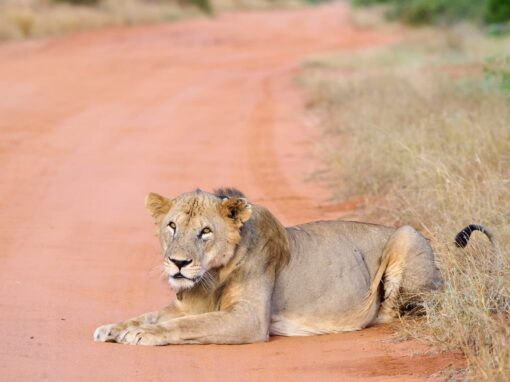
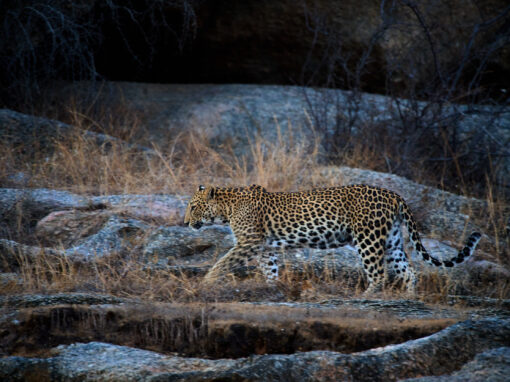
In Tsavo the animals often stand right by the track, in Bera leopards lie on granite rocks at some distance. The rule of thumb "the longer, the better" is therefore only half true. If you shoot exclusively at 600 mm, you come home with a hard drive full of eyes and not a single picture that shows where the animal actually lives.

Two cameras instead of changing lenses
If you own a second camera or can borrow one, bring it: one body with the telephoto, one with a standard zoom. Changing lenses in a dusty vehicle is exactly the moment when your sensor catches the specks you will later see in every sky. And when the cheetah starts its sprint, you have no time for it anyway. If you only have one camera, put the telephoto zoom on and leave it there.
Renting a camera for your safari instead of buying
Buying a super telephoto for a single trip only pays off if you want to keep photographing wildlife afterwards. Otherwise I would rent. Many camera stores and rental platforms lend telephoto zooms and primes for a few days to several weeks. I would keep three things in mind:
- Pick it up at least a week before departure and practise. If you use your lens for the first time in the jeep, you give away your first two game drives.
- Check the insurance: what happens after a drop, theft or dust damage abroad?
- Check the weight. Domestic flights in small aircraft often have a luggage limit of around 15 kg, usually in soft bags. A 600 f/4 in a hard case does not fit that.
Buying used is an honest third option. A used 100–400 or 150–600 hardly loses value after the trip if you treat it well.
What else belongs in your bag
- A beanbag. In Kenya mine lay on the lowered window frame and kept the telephoto steady. Bring it empty and fill it with rice or beans on site.
- Two or three memory cards, plus an evening backup of your pictures to a laptop or SSD
- Blower, microfibre cloth and a damp cloth for the camera body after every drive
- A rain cover or a large bin bag (in Tanzania we had the heaviest rain of the trip, and the hippos were still lying outside)
- Binoculars, because you should watch animals before searching for them through the viewfinder
- A soft camera bag instead of a hard case, so it fits between your feet in the vehicle
How to approach a trip like this as a whole is covered in the guide How to plan your first photo safari. And if you want to go deeper into lenses, there is more in the article on telephoto lenses for wildlife photography.
My recommendation in one sentence
A camera you can operate blindly, a telephoto zoom up to 500 or 600 mm, a beanbag and a second, shorter focal length. Everything else is luxury, worth talking about once the basics are in place.
On my photo tours to India we are eight people at most, and we go through gear and settings on site. You don't need a new camera for that 🙂